The History of Ainderby Hall Estate
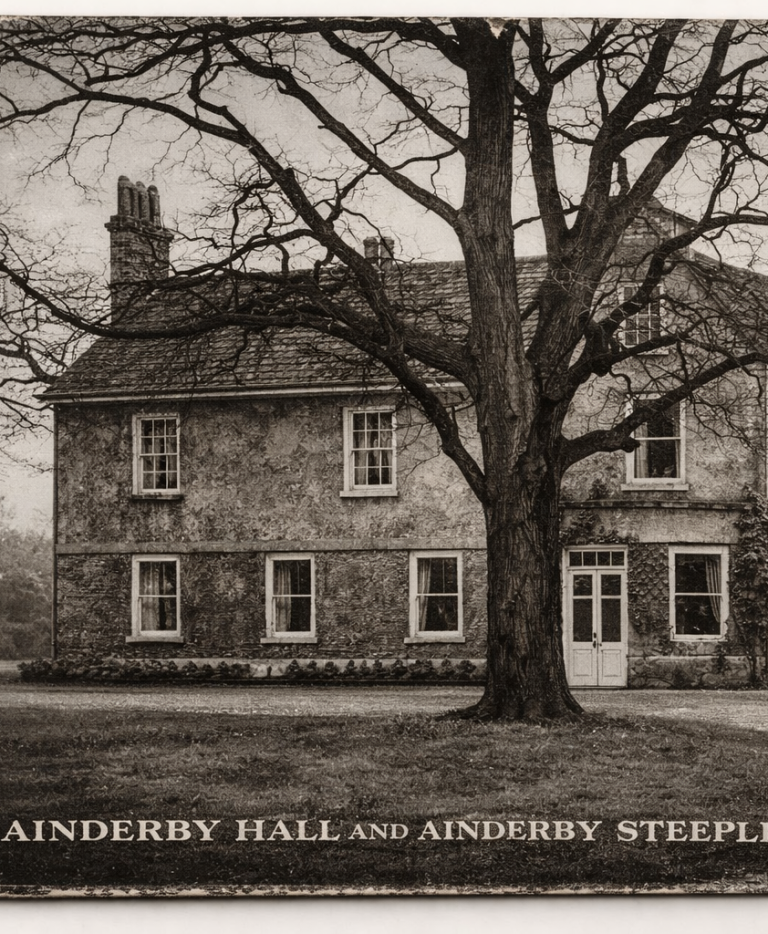
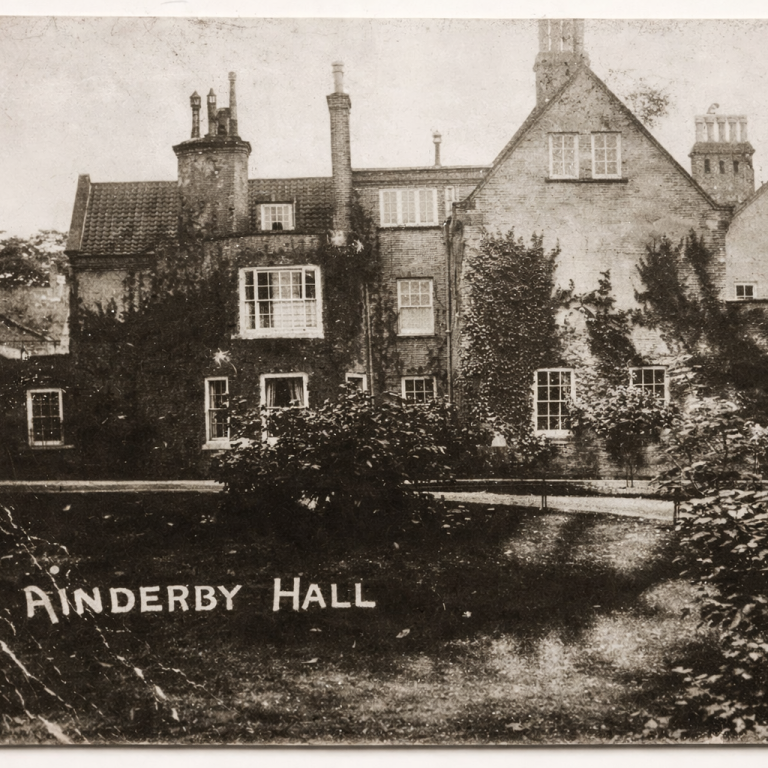
Ainderby Hall Estate stands at the heart of Ainderby Steeple, a conservation village in North Yorkshire, and represents over nine centuries of documented history, shaped by a wide succession of landholders, residents, tenants, and stewards. The estate’s story reflects England’s broader social, architectural, and landscape history, evolving from medieval manorial land through periods of gentry residence, tenancy, architectural transformation, and modern conservation-led stewardship.
Throughout its history, Ainderby Hall has functioned not only as a residence, but as a centre of local authority, agricultural management, cultural life, and care, continually adapting to changing social, economic, and historical conditions.
Possible Prehistoric Origin
While Ainderby Hall Estate is best documented from the medieval period onward, the form and setting of the estate suggest a far deeper past. The Hall occupies a distinctly circular site, with the village road wrapping around it in a manner highly unusual for later planned estates. This circular footprint is remarkably similar in scale and geometry to the nearby Thornborough Henges, one of the most significant Neolithic ritual landscapes in Britain.
Although no formal archaeological excavation has yet confirmed this, it is possible that the site of Ainderby Hall originated as a prehistoric henge or ceremonial enclosure, later reused and reinterpreted over centuries as a manorial and residential focus. Such continuity of place—where sacred or communal landscapes evolve into centres of power, residence, and stewardship—is well documented elsewhere in England and may form part of the deep-time story of Ainderby Hall Estate.
Early Origins and Medieval Ownership (11th–15th centuries)
The earliest recorded history of Ainderby dates to the Domesday Book of 1086, where it is listed as Eindrebi, held under the Crown following the Norman Conquest. Prior to 1066, the land was associated with Saxon lords, including Earl Edwin of Mercia, indicating its importance before Norman rule.
From the 12th century, the Furneaux (de Furneaux) family emerged as lords of the manor, holding Ainderby for several generations. In the early 14th century, ownership passed to Geoffrey le Scrope, founder of the powerful Scrope family of Masham, with the estate descending alongside the Scrope lands until political upheaval in the 15th century brought periods of Crown control.
Tudor, Stuart, and Post-Manorial Transition (16th–18th centuries)
In the early 16th century, the manor passed through the Strangways family, notably Sir Thomas Strangways and Sir James Strangways, before becoming caught up in wider national events. Following the attainder of Leonard Dacre in 1569, the estate was seized by the Crown and subsequently leased rather than held outright.
As manorial authority declined, Ainderby Hall continued to be occupied and managed by a succession of yeoman farmers, clerical residents, and agricultural tenants, including figures such as John Calvert, Wilfrid Calvert, Rev. Henry Wastell, John Reed, and John Atkinson. This period reflects the estate’s continuity as a lived and worked place even as formal manorial structures fell away.
The Armitage, Wallace, and Victorian Period (19th century)
One of the most formative periods in the estate’s history began in the early 19th century with William Armitage (1798–1883), a prominent industrialist, ironmaster, and landowner associated with the Farnley Hall family. Under the Armitages and their extended Wormald connections, Ainderby Hall was firmly established as a Victorian gentleman’s residence, reflecting values of stewardship, productivity, and community responsibility.
During the mid-19th century, the Hall was also home to Sir James Maxwell Wallace and his wife Dame Grace Wallace, a noted writer and translator. Their residence adds an important cultural and intellectual dimension to the estate’s history, linking Ainderby Hall to literary life, military service, and wider imperial networks.
The later Victorian period saw a number of shorter-term residents and tenants, including Captain Creyke, Major Dent, Amias Christopher Thomas Orde-Powlett, and the Hon. Gospheric Thomas Dundas and Maud Dundas, reflecting the changing patterns of landownership and tenancy characteristic of the late 19th century.
Late Victorian and Edwardian Residents (Late 19th–Early 20th centuries)
By the late 19th century, Ainderby Hall was occupied by Charles Hubert Backhouse, a member of the prominent banking family associated with Barclay & Co. His residence links the estate to nationally significant financial and horticultural heritage, particularly through the Backhouse family’s contributions to botany and plant breeding.
In the early 20th century, the Hall became the home of Alan Cecil Lupton, a farmer and Justice of the Peace, along with his family. During this period, Ainderby Hall remained a substantial private residence, set within mature pleasure gardens and productive farmland.
The early to mid-20th century also includes documented occupancy by a range of residents and tenants—among them Frances Holt, A. E. Holt, George Anthony King, Thomas Humphrey, John and L. R. Richmond, John Clapham, and Thomas William Granville Place and Dorothy Place—reflecting both stability and transition in the years surrounding the Second World War.
The Mortimer Era and Architectural Transformation (Mid–Late 20th century)
A defining chapter in the estate’s modern history began in 1949, when my grandparents, Robert Shaw Mortimer and Elizabeth Grant Mortimer, acquired Ainderby Hall. Both were architects, and Elizabeth Mortimer was a pioneering figure, among the early generation of women to qualify in the profession. Together, through their practice Mortimer Partners, they brought a thoughtful and forward-looking approach to the estate.
Following post-war decline, much of the original Hall building was no longer viable. Key historic elements were retained while the estate was carefully adapted. Their work received Civic Trust Awards in 1959, recognising the exceptional integration of modern architecture within a historic rural landscape.
Beyond architecture, they safeguarded the estate’s trees, gardens, and views, ensuring that Ainderby Hall continued to contribute positively to the character of Ainderby Steeple as a conservation village.
Contemporary Stewardship and Living Practice (21st century)
In the present day, Ainderby Hall Estate continues its long tradition of stewardship through family care and conscious guardianship. I am the current steward of the estate, carrying responsibility not only for its buildings and land, but for its continuity, integrity, and future direction.
My role draws together the estate’s deep historical layers with a contemporary understanding of place, wellbeing, and restoration. Alongside practical estate management, I work as an energy practitioner and radionic healer, specialising in practices that support balance, coherence, and reconnection—both within individuals and within the environments they inhabit.
This approach reflects an emerging understanding that historic estates are living systems, shaped by centuries of human presence, intention, conflict, renewal, and care. My stewardship acknowledges these accumulated layers and seeks to support Ainderby Hall as a place of integration, where past and present are brought into alignment and where responsibility is understood as both physical and energetic.
Significance
Ainderby Hall Estate is valued not only for its architecture and historic landscape, but for the exceptional continuity and diversity of its occupancy, its enduring contribution to village identity, and its nationally recognised role in 20th-century architectural and conservation practice.
With documented roots extending back to the Domesday Book, possible origins reaching into prehistoric ritual landscapes, and a continuous record of residence, tenancy, and stewardship spanning centuries, Ainderby Hall represents a rare convergence of deep-time heritage and lived family history.
Today, it stands as a distinctive example of a privately held heritage estate actively managed for future generations, rooted firmly in the history and character of North Yorkshire while remaining a living, evolving place.